• Jump to Header
  • Jump to Main Content
  • Jump to Footer
Michigan State University
International Studies & Programs
  • Give
  • Contact

International Studies & Programs

  • Home
  • |
  • About
    • About ISP
    • Visits and Delegations
    • Careers
    • Funding Resources
    • Contact
  • |
  • Offices and Programs
    • MSU's International Organization
    • African Studies Center
    • Alliance for African Partnership
    • American Semester Program & Exchanges
    • Asia Hub
    • Asian Studies Center
    • Canadian Studies Center
    • Center for European and Eurasian Studies
    • Center for Latin American and Caribbean Studies
    • Center for Gender in Global Context
    • Center for Global Learning and Innovation
    • Community Volunteers for International Programs
    • Fulbright Programs
    • Global Health Institute
    • International Business Center
    • Japan Center for Michigan Universities
    • Muslim Studies Program
    • Tanzania Partnership Program
    • Office for Global Health, Safety and Security
    • Office for Education Abroad
    • Office for International Students and Scholars
    • Office of International Studies in Education
    • Peace Corps
    • Visiting International Professional Program
    • Volunteer English Tutoring Program
    • World Agriculture Center
  • |
  • Global Learning
    • Global Learning @ MSU
    • Center for Global Learning and Innovation
    • Education Abroad & Domestic Study Away
    • Extra- and Co-curricular Programs
    • International Students and Scholars
    • Language Study
    • Global Inclusion
    • Fulbright Programs
    • Majors & Minors
    • Student Funding
    • Peace Corps
  • |
  • Research & Partnerships
    • MSU's Global Network
    • Faculty Funding
    • Partnership Platforms
    • New Partnership Development
  • |
  • Global Safety
    • About the Office
    • Emergency Assistance
    • Advisory Committees
    • Students
    • Faculty and Staff
    • Health and Safety Resources
    • MSU-Sponsored International Travel
    • Global Travel & Remote Work Registry
    • Elevated-Risk Destinations
  • |
  • News & Events
    • News
    • Events
    • Global Focus Photo Contest
    • Global Festival
    • International Awards
    • International Education Week
International Studies & Programs
  • Home
  • About
  • Offices and Programs
  • Global Learning
  • Research & Partnerships
  • Global Safety
  • News & Events

< Home

< About

  • About ISP
  • Visits and Delegations
  • Careers
  • Funding Resources
  • Contact

< Offices and Programs

  • MSU's International Organization
  • African Studies Center
  • Alliance for African Partnership
  • American Semester Program & Exchanges
  • Asia Hub
  • Asian Studies Center
  • Canadian Studies Center
  • Center for European and Eurasian Studies
  • Center for Latin American and Caribbean Studies
  • Center for Gender in Global Context
  • Center for Global Learning and Innovation
  • Community Volunteers for International Programs
  • Fulbright Programs
  • Global Health Institute
  • International Business Center
  • Japan Center for Michigan Universities
  • Muslim Studies Program
  • Tanzania Partnership Program
  • Office for Global Health, Safety and Security
  • Office for Education Abroad
  • Office for International Students and Scholars
  • Office of International Studies in Education
  • Peace Corps
  • Visiting International Professional Program
  • Volunteer English Tutoring Program
  • World Agriculture Center

< Global Learning

  • Global Learning @ MSU
  • Center for Global Learning and Innovation
  • Education Abroad & Domestic Study Away
  • Extra- and Co-curricular Programs
  • International Students and Scholars
  • Language Study
  • Global Inclusion
  • Fulbright Programs
  • Majors & Minors
  • Student Funding
  • Peace Corps

< Research & Partnerships

  • MSU's Global Network
  • Faculty Funding
  • Partnership Platforms
  • New Partnership Development

< Global Safety

  • About the Office
  • Emergency Assistance
  • Advisory Committees
  • Students
  • Faculty and Staff
  • Health and Safety Resources
  • MSU-Sponsored International Travel
  • Global Travel & Remote Work Registry
  • Elevated-Risk Destinations

< News & Events

  • News
  • Events
  • Global Focus Photo Contest
  • Global Festival
  • International Awards
  • International Education Week
  • Give
  • Contact

March 30, 2026 | Read time 5 min

Graduate voice: Why international research matters

Jana Woerner is a doctoral candidate in the Departments of Integrative Biology, and Ecology, Evolution and Behavior. She is a 2026 recipient of the Homer Higbee International Education Award.

I would not be the field scientist I am today without my time in Kenya. Dr. Kay Holekamp took a huge chance on me as a recent graduate with limited research experience; my years with the Mara Hyena Project have been some of the most formative of my life.

When I first arrived, I had signed up to spend a year away from my family, friends, hobbies and all the comforts of home to study an animal I had only seen once or twice in the wild during a study abroad program in South Africa. I still remember my very first day in the field with the hyenas, worrying that I might find them boring and regret moving halfway across the world. Fast forward seven years and here I am.

In Kenya, I learned the technical skills of being a field scientist: how to keep track of more than 200 individual hyenas, record detailed behavioral observations, collect biological samples, and deploy novel biologging collars that give us a deeper look into a hyena’s life.
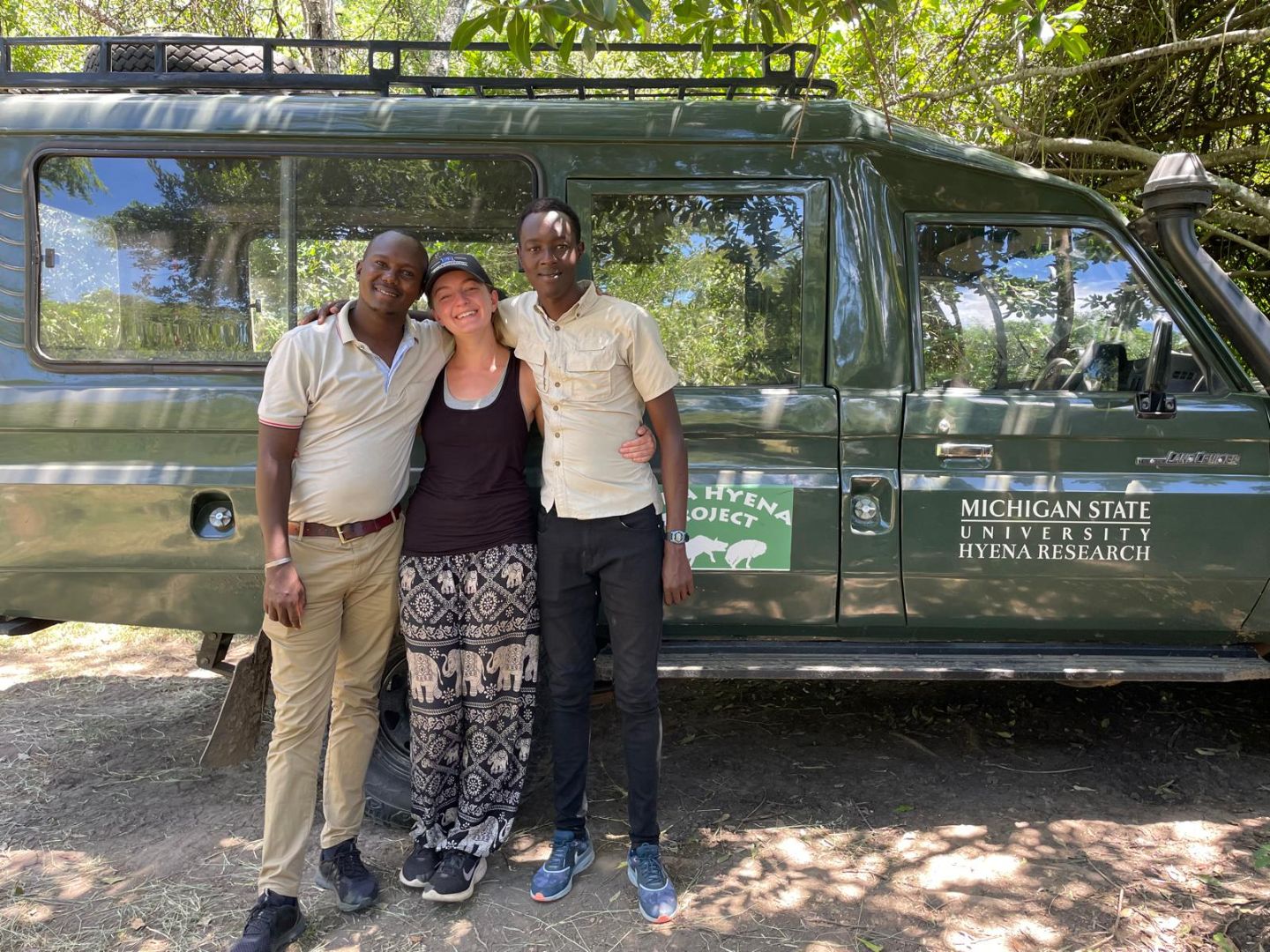
L-R: Benson, Woerner and Ben stand in front of one of the vehicles used at a research camp. Courtesy photo.

I also learned the many non-scientific skills that fieldwork demands. I learned how to keep our 20-year-old field truck running, how to build meaningful relationships with the local community, and how to survive long, intense rainy seasons. I learned how to get the car unstuck from wet, sticky black cotton soil, how to get the car unstuck from deep buffalo wallows, and how to get the car unstuck from dangerous rock fields (can you tell we had a lot of car issues?). Most importantly, I learned how to persevere and creatively solve problems with limited resources.

Of course, I would never have made it through my time in Kenya without an incredible support network. There are too many people to name, but “our guys” —  Philimon, Moses and Stephen — at camp not only took care of me, but they also spoiled me (as much as anyone can be spoiled in a remote camp without indoor plumbing).

Benson Pion, a long-time researcher with the Mara Hyena Project, became like a big brother to me, especially during the pandemic when I suddenly found myself running a remote research camp alone. Our regular check-ins, his encouragement and, even his occasional Italian food deliveries all the way from Nairobi, helped me push through some of the hardest moments of living in such an isolated place. The kindness and mentorship I received have stayed with me wherever I go. The people I worked with in Kenya shaped both the scientist and the person I’ve become, and I try to pass on that same support and mentorship to the undergraduates I now work with at Michigan State.

My dissertation research is part of a larger collaborative project called “Communication and Coordination Across Scales”, led by Dr. Ari Strandburg-Peshkin at the Max Planck Institute of Animal Behavior in Germany. Ari and I first met in Kenya in 2022 while collaring an entire group of spotted hyenas. Ari strongly encouraged me to apply for funding through the German Academic Exchange Service (DAAD) to spend several months working with her group in Germany. Her lab was using the same cutting-edge biologging collars to study communication and coordination in animal groups, so it was a perfect intellectual fit.
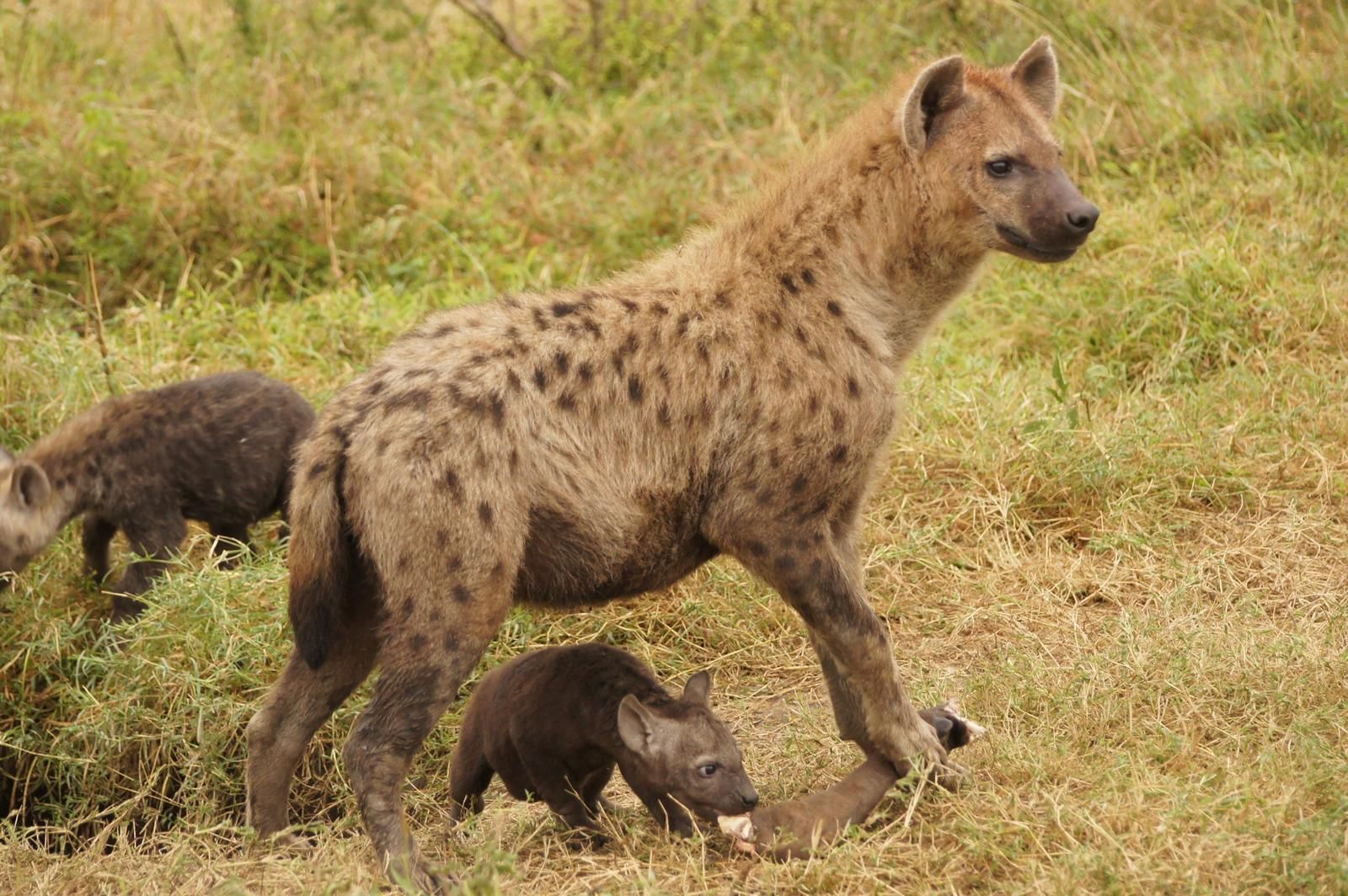
Hyenas. The large one is named after Woerner (Yana). Courtesy photo.

At the same time, my advisor, Kay Holekamp, was preparing for retirement and relocating to California, which meant my alternative was essentially working from an empty office at Michigan State. The choice was easy.

Being part of such an interdisciplinary and collaborative environment pushed me to think about my work in new ways. My colleagues at the Max Planck Institute have played an incredibly important role in both my research and my personal life.

I was born in Germany but moved to the United States when I was ten years old. Over time I assimilated quickly and eventually stopped mentioning that I was from Germany; not because I wanted to distance myself from it, but because it felt like a small part of my life after so many years in America.

While I was there, I quickly realized how much I enjoy aspects of the European lifestyle: being able to live without a car, having easy access to fresh and affordable food, and simply the pace of daily life. I was also able to reconnect with some of my extended family that remained in Germany.
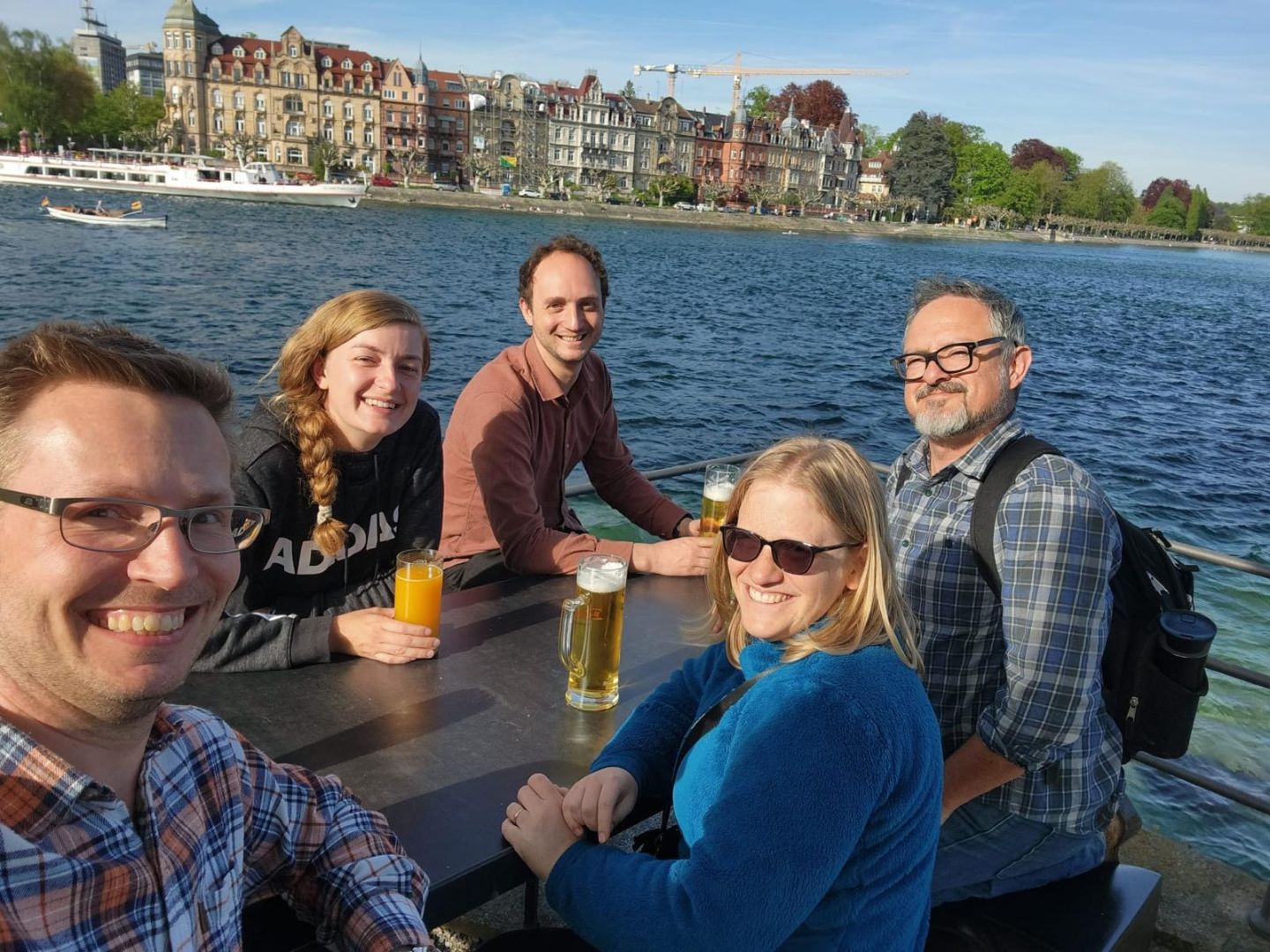
Woerner celebrates with professors and collaborators at a beer garden in Germany. Sitting beside Woerner is Eli Strauss. Front middle is Ari Strandburg-Peshkin. Courtesy photo.

Thanks to generous UDF funding from Michigan State, I was able to extend my stay for another year.

Leaving Germany and returning to the U.S. was surprisingly difficult. What the future looks like, changes almost every day. I want to continue working in large carnivore research. For my Ph.D., I primarily focus on basic research questions about foraging behavior and movement but moving forward, I’m increasingly interested in applying these tools to conservation problems. In the short term, I hope to return to the Max Planck Institute of Animal Behavior for a postdoctoral position to continue the research I started during my Ph.D.

Banner image: Woerner with her "most trusted co-worker."

About

  • About ISP
  • Visits and Delegations
  • Careers
  • Funding Resources
  • Contact

Offices and Programs

  • MSU's International Organization
  • Community Volunteers for International Programs
  • Volunteer English Tutoring Program

Global Learning

  • Global Learning @ MSU
  • Center for Global Learning and Innovation
  • Education Abroad & Domestic Study Away
  • Extra- and Co-curricular Programs
  • International Students and Scholars
  • Language Study
  • Global Inclusion
  • Fulbright Programs
  • Majors and Minors
  • Student Funding
  • Peace Corps

Research & Partnerships

  • MSU's Global Network
  • Faculty Funding
  • Partnership Platforms
  • New Partnership Development

Global Safety

  • About the Office
  • Emergency Assistance
  • Advisory Committees
  • Students
  • Faculty and Staff
  • Health and Safety Resources
  • High Risk Destinations
  • Global Travel & Remote Work Registry
  • Elevated-Risk Destinations

News & Events

  • News
  • Events
  • Global Focus Photo Contest
  • Global Festival
  • International Awards
  • International Education Week

Address

Michigan State University
International Center
427 N. Shaw Lane
Room 209
East Lansing, MI 48824-1035

Phone

517-355-2350

Email

infonew@isp.msu.edu

Website Issues

webmaster@isp.msu.edu

Releases and Statements

Follow Us

  • Visit our Facebook page
  • Visit our page on X
  • Visit our Instagram page
  • Visit our YouTube page

If you're having accessibility issues, please let us know.

  • Contact Information|
  • Site Map|
  • Privacy Statement|
  • Site Accessibility|
  • Call MSU: (517) 355-1855|
  • Visit: msu.edu|
  • Notice of Nondiscrimination|

SPARTANS WILL|© Michigan State University|